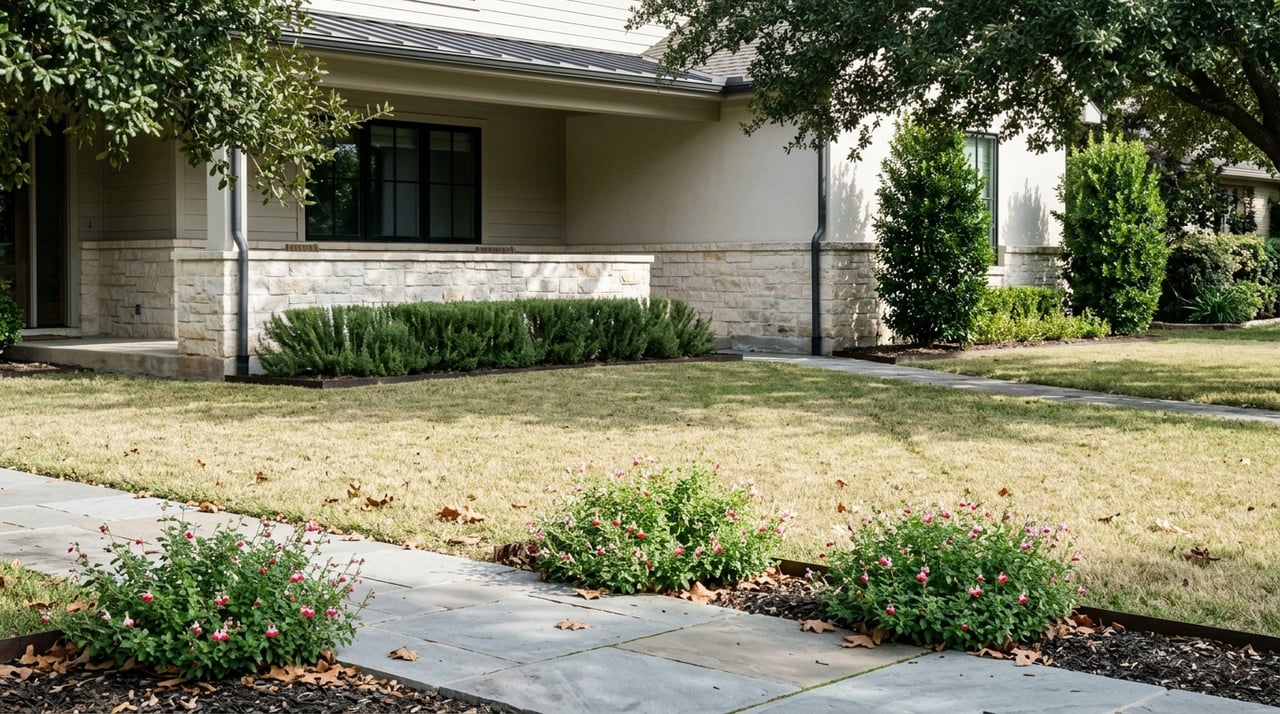
A house came up for review in front of Austin's Historic Landmark Commission not long ago. It was a modest 1951 home in Tarrytown, the kind with a low roofline and a kitchen nobody had touched since the Johnson administration. The filing described it plainly: the structure itself was almost beside the point. It was being marketed for its lot.
That single filing captures something buyers moving through Tarrytown, Old Enfield, Pemberton Heights, and Bryker Woods keep learning the hard way. In most of Austin, a home's price tracks its condition. In this corridor, price often tracks the dirt underneath it, and a dated house on a strong lot can outprice a fully renovated one two streets over. If you are shopping this market with a per-square-foot spreadsheet, you are measuring the wrong thing.
What the Appraisal District Already Knows
Every parcel in Travis County carries two separate numbers on file: a land value and an improvement value. Anyone can look them up through the Travis Central Appraisal District's public search. In much of Old West Austin, that split runs 50 to 70 percent land. On a home listed at $1.5 million, that means somewhere between $750,000 and $1.05 million of the price tag is the parcel itself, not the walls, the roof, or the kitchen inside them.
That is not a quirk of one appraiser's judgment. Texas law requires appraisal districts to value property using mass appraisal, applying a shared model across classes of similar parcels rather than pricing each home individually from scratch, as the Texas Comptroller's guidance on valuing property lays out. That approach works reasonably well when the homes in a class actually resemble each other. In a neighborhood built out between 1853 and 1953, where a fully restored period house sits next to an original ranch that hasn't been touched, the model has to work harder to tell those two properties apart, and the land component ends up carrying more of the explanatory weight than the house does.
Why the Per-Square-Foot Number Stops Working
Homes in Tarrytown were selling for roughly $673 per square foot as of August 2026, against a citywide median closer to $302. That gap alone tells you the neighborhood commands a premium. What it does not tell you is where that premium lives.
Between the first quarter of 2024 and the first quarter of 2026, Tarrytown's median price per square foot climbed from $520 to $565. A rising number like that reads as evidence that the homes themselves are getting more valuable. Often the opposite is closer to true. Two houses of identical square footage, one on a quarter acre and one on a full acre, will report the same price-per-square-foot figure even though the larger lot might be worth $200,000 to $500,000 more on its own. The metric flattens exactly the variable that matters most here.
| Price per square foot | What it's really measuring | |
|---|---|---|
| Citywide Austin median | About $302 | A blend of structure and land across every submarket |
| Tarrytown (Aug. 2026) | About $673 | Increasingly, the lot beneath a modest structure |
A buyer who screens listings by cost per square foot alone will do two things wrong at once. They will pass over a dated, unglamorous house sitting on an exceptional parcel, assuming it's overpriced for what it is. And they will overpay for a beautifully finished home on a compromised lot, because the finishes are the part a spreadsheet can see.
Where the Land Ends and the Review Process Begins
Deciding you're buying land is the easy part. Acting on that decision inside Old West Austin is where the friction actually shows up.
Old Enfield, Pemberton Heights, and Bryker Woods sit inside a National Register Historic District with roughly 1,574 contributing structures built between 1853 and 1953. If a house is classified as a contributing structure, tearing it down or substantially altering its exterior routes through the City's Historic Preservation Office and the Historic Landmark Commission before a permit gets released. In practice, that means documentation requirements, staff review against the Secretary of the Interior's standards, and sometimes design conditions attached to what gets approved.
Tarrytown carries a parallel set of constraints worth checking before you assume a lot is a clean teardown. Lots near Shoal Creek or Pease Park can fall inside floodplain or Critical Water Quality Zone boundaries under the City's watershed rules, which shape where and how much square footage a new build can actually claim. Mature tree canopy across the neighborhood, much of it protected under the city's tree ordinance, can add real site-prep cost and redesign work before a shovel goes in the ground.
None of this shows up in a listing photo. It shows up three months into a transaction, when a buyer who priced the lot correctly discovers the timeline attached to using it.
The Timeline Nobody Puts in the Listing
For straightforward projects on unconstrained lots, plan review typically runs three to six months before a permit is in hand. For anything touching a contributing structure, a floodplain overlay, or significant tree protection, that window extends, and construction itself typically runs nine to eighteen months depending on scope. A buyer comparing an original-condition home against a fully renovated one two blocks away needs to price that entire span, not just the construction budget, into the comparison. A house that looks like a bargain on a per-square-foot basis can turn into the more expensive path once holding costs, financing during construction, and a year and a half of patience get added to the total.
Reading a Listing Like the Land Is the Point
A few habits change how this market reads once you stop trusting the headline price-per-square-foot number.
- Pull the TCAD record before you tour the house. The land and improvement split is public. If land accounts for most of the value, you are evaluating a parcel with a structure attached, not the reverse.
- Confirm historic district and overlay status early. Old Enfield, Pemberton Heights, and Bryker Woods carry National Register status. Tarrytown lots can carry their own watershed and tree overlays that matter just as much. Either can add months to any exterior work.
- Compare within the same condition tier. An original 1950s house, a partial renovation, and a full teardown-rebuild each trade in a different price band. Averaging across all three produces a number that describes nothing real.
- Price the calendar, not just the construction bid. If a rebuild realistically takes a year and a half from purchase to move-in, that is part of the true cost of choosing that lot over a finished home.
A short FAQ
Does every older home in this corridor require historic review before it can be altered? No. Review requirements attach to homes classified as contributing structures within a recognized historic district, or to work that falls inside a protected overlay like a floodplain or Critical Water Quality Zone. Confirming a specific property's status is a matter of checking city records before assuming either way.
Is the land-heavy pricing pattern unique to Tarrytown? It shows up most visibly in the older, close-in West Austin neighborhoods, including Old Enfield, Pemberton Heights, and Bryker Woods, where lot scarcity near downtown outweighs the age of what's built on top of it. It is less pronounced in newer construction submarkets where the structure itself represents most of the value.
If land is most of the value, does renovating even make financial sense? It depends entirely on the individual lot and the condition of what's already standing. That is precisely why a blended neighborhood average, whether expressed in price per square foot or median sale price, cannot answer the question for any specific address. It takes a parcel-level look at land value, improvement value, and realistic renovation or rebuild costs side by side.
Buying in this part of Austin rewards patience and the right questions asked before you write an offer, not after. If you're weighing a renovation against a rebuild, or trying to make sense of why two homes with the same square footage carry very different price tags, Whitney Newton and the team at Newton Residential Group spend their days inside exactly this kind of decision. Reach out and we'll walk the numbers with you before you fall in love with the wrong lot.
This article is general information, not legal, tax or financial advice. Consult a qualified professional about your situation.